
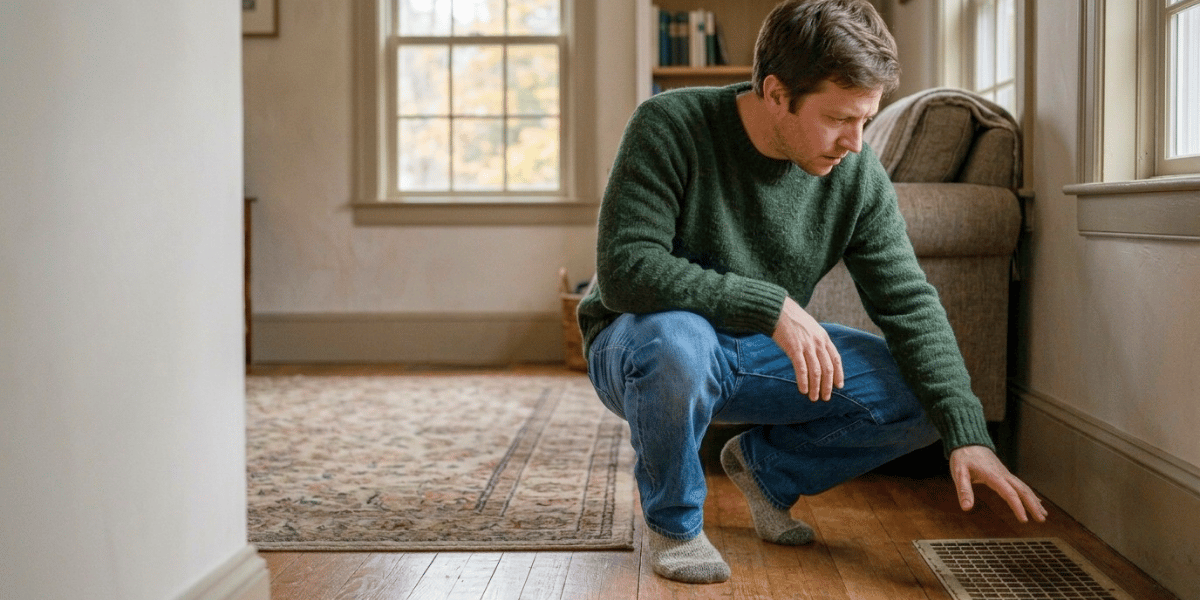
You turn on the heat, hear the system kick on, and wait for that familiar warm air to come through the vents.
Except when you hold your hand up to one, the air feels surprisingly cool.
Now you’re wondering whether something is wrong with your heater. After all, if the thermostat is set to HEAT, shouldn’t the air coming out feel warm?
Well, not always.
Here in North Georgia, plenty of homes rely on heat pumps, which work a little differently than traditional furnaces. Depending on your heating system, air that feels cool against your hand might actually be warming your home just fine.
Of course, there are times when cold air really does mean something isn’t working properly.
But how can you tell the difference? Let’s walk through what’s normal, what you can check yourself, and when it’s time to have someone take a closer look.
Quick Answer: Why Is My Heater Blowing Cold Air?
Your heater may blow cold air because the thermostat fan is set to ON, your heat pump is defrosting, or the system is still warming up. Heat pumps can also produce air that feels cool even when they’re heating normally. However, dirty filters, restricted airflow, or faulty heating components can cause genuine heating problems.
If your home is reaching the temperature set on your thermostat, the system may be working normally. If the temperature keeps dropping or the air stays cold, it’s time to investigate.
First, Is the Air Actually Cold or Just Not Very Warm?
Here’s something that surprises a lot of homeowners: air doesn’t have to feel hot against your hand to heat your home.
Your skin is naturally warmer than the air inside your house. So when air moves across your hand, it can feel cool even if it’s warmer than the room.
This is especially noticeable with heat pumps.
A gas furnace typically sends noticeably hotter air through your vents. A heat pump usually delivers air that’s warm, but not nearly as hot as what you might expect from a furnace.
If you’ve recently moved into a home with a heat pump or switched from a furnace, that difference can catch you off guard.
Here’s a better way to check: Instead of judging the heat by how it feels against your hand, watch your thermostat. If the indoor temperature is gradually rising and your home reaches the setting you’ve chosen, your system may be working exactly as it should.
If the temperature isn’t budging, that’s when it’s worth investigating.
1. Your Heat Pump Might Be Working Just Fine
Heat pumps are a popular choice around Metro Atlanta because they can handle both heating and cooling.
Unlike a gas furnace, which produces heat by burning fuel, a heat pump moves heat from the outdoor air into your home.
Even when it’s cold outside, there’s still heat available for the system to transfer indoors.
Because of this, heat pumps often run longer and deliver a steadier stream of moderately warm air rather than short bursts of very hot air.
That doesn’t necessarily mean your system is struggling.
Here’s what to pay attention to:
- Your house is warming up: If the indoor temperature is rising, that’s a good sign.
- The air feels warm, but not hot: That’s common with heat pumps.
- The system runs longer than a furnace might: Longer heating cycles can be normal, especially during colder weather.
What you don’t want is a system that runs for hours while the house keeps getting colder.
If that’s happening, there may be a problem beyond normal heat pump operation.
2. Your Thermostat Fan Could Be Set to ON
Before assuming something is broken, take a quick look at your thermostat.
Most thermostats have two common fan settings: AUTO and ON.
| Fan Setting | What It Means |
| AUTO | The fan generally runs when the system is actively heating or cooling. |
| ON | The fan keeps circulating air even when the system isn’t producing heat. |
If the fan is set to ON, you may feel room-temperature air coming through the vents between heating cycles.
And because moving air can feel cool against your skin, it’s easy to mistake that for a heater blowing cold air.
Try this: Switch the fan setting to AUTO and see whether the airflow stops between heating cycles.
If it does, you’ve probably found your answer.
Some systems also have a CIRCULATE setting that runs the fan periodically, so check that setting too if your thermostat offers it.
3. Your Heat Pump May Be Defrosting
This one sounds a little strange until you know what’s happening.
On cold, damp mornings in North Georgia, frost can build up on the outdoor part of your heat pump.
Your system has a built-in way to handle that. Every so often, it switches into a defrost cycle to melt the frost and keep operating efficiently.
During that process, you might notice cooler air coming through the vents for a short time. Depending on the system, supplemental heat may help keep the indoor air comfortable.
You might even see what looks like smoke coming from the outdoor unit.
Don’t panic. If it’s actually steam from melting frost during defrost, that’s normal.
So, when should you be concerned?
If the outdoor unit stays covered in thick ice, the system repeatedly struggles to defrost, or your house stops warming properly, it’s worth having a technician check it.
A little frost can be normal. An outdoor unit that remains heavily iced over isn’t.
4. The Blower Might Start Before the Heat Is Ready
Have you ever noticed a brief rush of cooler air right when your heater starts?
Depending on the equipment, the blower may begin circulating air before the system has reached its normal heating temperature.
Some systems also keep the fan running briefly after a heating cycle ends to move remaining heat into the house.
Neither situation automatically means something is wrong.
The important question is whether the air warms up once the heating cycle gets going.
If it does and the house reaches the thermostat setting, you probably don’t have much to worry about.
If the air stays cool throughout the cycle, however, it’s time to look beyond normal startup behavior.
5. A Dirty Air Filter Could Be Making Things Worse
Your air filter might not seem connected to a heater blowing cold air, but restricted airflow can create real heating problems.
When a filter becomes heavily clogged with dust, pet hair, and debris, it makes it harder for air to move through your HVAC system.
What happens next depends on your equipment.
In a furnace, poor airflow can contribute to overheating. That may trigger a safety control that shuts off the burners while the blower continues running.
With a heat pump, restricted airflow can reduce heating performance and contribute to other operating problems.
You might notice weaker airflow, uneven temperatures, or a house that takes longer than usual to warm up.
What can you do?
Pull out the filter if it’s safely accessible and check its condition. If it’s heavily coated in dust, replace it with the correct size and type recommended for your system.
While you’re at it, make sure supply vents and return grilles aren’t blocked by furniture, rugs, or other household items.
If the filter is clean but airflow still seems unusually weak, there may be another issue that needs professional attention.
6. Your Heater May Not Be Producing Enough Heat
So far, we’ve covered several reasons your vents might feel cool even when the system is operating normally.
But what if you’ve checked the thermostat and filter, given the system time to warm up, and your house still feels cold?
At that point, there may be a problem with the heating equipment itself.
The possible causes depend on your system.
A gas furnace might have an issue with its ignition system, burners, or safety controls. A heat pump could have a problem involving its compressor, refrigerant system, controls, or supplemental heat.
You don’t need to figure out which part is responsible. That’s what a professional diagnosis is for.
Instead, pay attention to a few things:
- Is the indoor temperature dropping? Your system may not be producing enough heat.
- Does the heater keep shutting off? Frequent, unexpected shutdowns can point to an operating problem.
- Is the airflow unusually weak? There may be a restriction or blower issue.
- Are there new noises or smells? Those details can help a technician narrow down the cause.
If your heater isn’t keeping up, don’t keep raising the thermostat hoping it will eventually catch up. A higher setting won’t fix a mechanical problem.
What Should You Check Before Calling for Heating Repair?
If your heating vents feel cold, there are a few safe things you can check before scheduling a service call.
| What to Check | What to Do |
| Thermostat mode | Make sure it’s set to HEAT and the target temperature is above the current room temperature. |
| Fan setting | Switch from ON to AUTO to avoid continuous airflow between heating cycles. |
| Heating cycle | Give the system time to start and see whether warmer air follows. |
| Air filter | Check for heavy dust buildup and replace the filter if needed. |
| Room temperature | Watch whether the indoor temperature rises toward your thermostat setting. |
| Unusual symptoms | Note new noises, persistent odors, weak airflow, or frequent shutdowns. |
If a simple thermostat adjustment or filter replacement solves the problem, great.
But if the house still isn’t warming up, there’s no reason to keep guessing.
When Should You Call a Professional About Cold Air From Your Vents?
Here’s where we’d draw the line between something to keep an eye on and something that deserves a closer look.
Consider scheduling a heating repair if:
- Your thermostat is set to HEAT, but the indoor temperature keeps falling.
- Cool air continues coming from the vents throughout the heating cycle.
- Your system runs unusually long without reaching the set temperature.
- The heater repeatedly starts and stops without warming the house.
- Your heat pump stays heavily iced over.
- You notice new loud noises or persistent unusual odors.
If you smell gas, leave the area and contact your gas utility or emergency services from a safe location. For smoke or a suspected electrical hazard, shut the system off if it’s safe to do so and seek appropriate help.
Otherwise, a professional inspection can help determine whether you’re dealing with an airflow problem, a thermostat issue, or something inside the heating equipment.
Frequently Asked Questions
Why is my heat pump blowing cold air in heat mode?
A heat pump may blow air that feels cool in heat mode because it delivers lower-temperature air than a gas furnace or is temporarily running a defrost cycle. If your home is reaching the thermostat setting, this may be normal. If the air stays cold and your house isn’t warming up, the system may need repair.
Why is my heater blowing cold air when the thermostat is set to HEAT?
If your heater is blowing cold air while the thermostat is set to HEAT, the fan may be set to ON, the system may still be warming up, or the heating equipment may have a problem. Try switching the fan to AUTO and checking whether the indoor temperature rises. If your home stays cold, schedule an inspection.
Is it normal for a heater to blow cold air when it first turns on?
Yes, some heating systems briefly blow cooler air when they first turn on because the blower starts before the air has fully warmed up. This depends on the equipment and its controls. If the air remains cold throughout the heating cycle and your home isn’t getting warmer, there may be a problem.
How can I tell if my heater is working properly?
The simplest way to tell if your heater is working properly is to check whether your home reaches the temperature set on your thermostat. Air from a heat pump may feel cooler than furnace air, but it should still warm your home. If you’re unsure how to test your heating system, our fall HVAC checklist walks you through a few simple checks. If the temperature keeps dropping or your heater runs without warming the house, professional service may be needed.
Should I turn on emergency heat if my heat pump is blowing cold air?
Don’t switch to emergency heat just because your heat pump is blowing air that feels cool. Emergency heat is intended for situations when the heat pump isn’t working properly, and it can cost more to operate. Check whether your home is warming up first, and follow your system manufacturer’s guidance or a technician’s instructions.
Cold Air From Your Vents? Let’s Find Out Why.
Cool air from your heating vents doesn’t always mean your heater is broken.
Sometimes it’s simply how a heat pump delivers warmth. Other times, a thermostat setting or a brief delay at the beginning of a heating cycle explains what you’re feeling.
What matters most is whether your home is actually getting warmer.
If the system keeps running without reaching the temperature you’ve set, or something sounds or smells different, it’s worth getting it checked.
Cool Masters Services has helped homeowners throughout Metro Atlanta and Greater Gwinnett stay comfortable since 2005. Whether you’re dealing with a heat pump that isn’t keeping up or a furnace that’s stopped producing heat, our team can inspect your equipment, explain what’s happening, and help you understand your options.
Schedule an appointment with Cool Masters Services and let’s figure out why your home isn’t warming up.